Walking for Seniors: How Far, How Often, and How to Stay Safe Walking Alone
Published September 30, 2026
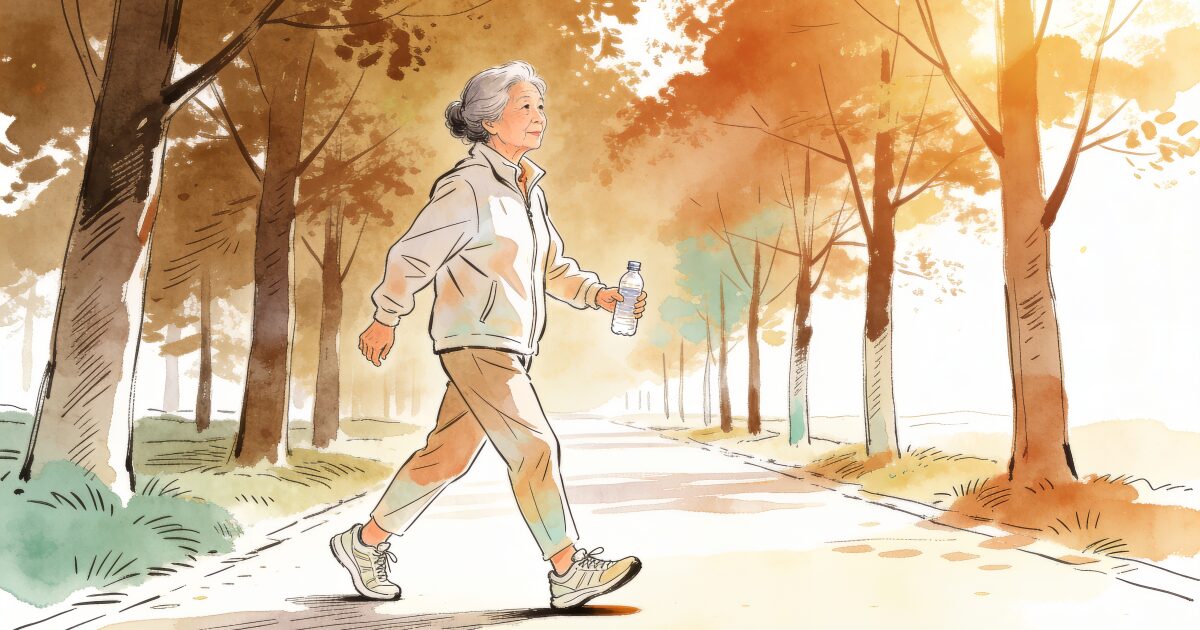
If you asked a room of doctors to name one exercise for older adults, most would say walking. Not because it is the most effective at any single thing, but because it is the one people are still doing a year later.
The call that never comes is the scariest. AssureOkay ensures someone always knows.
Try free for 3 daysIt needs no kit, no class and no changing room. It fits around the shops, the dog, the grandchildren and the weather. And it does more for your heart, your mood and your stamina than most people give it credit for.
This guide covers how to start if you have not walked for exercise in a while, how far and how often to aim for in honest terms, what to wear on your feet, what to do when the weather is against you, and how to stay safe when you walk on your own.
Why walking is the exercise most people stick with
Every other form of exercise asks something of you before you start: a pool, a class timetable, a set of bands, a mat you have to get down to. Walking asks only that you open the front door.
That low barrier is exactly why it works. The health benefits of exercise come from doing it regularly for years, not from doing it intensely for a month. Walking is the exercise that survives bad weeks, bad knees and bad moods, because it can be as short and as gentle as the day demands.
It is also good for you in ways that add up. Regular walking helps the heart, blood pressure and blood sugar, keeps weight steadier, lifts mood, helps sleep, and keeps the legs strong enough for stairs and shopping. Done outdoors, it adds daylight and fresh air, which do their own quiet work on mood and sleep.
What it does not do much of is build upper-body strength or train balance directly. That is why our wider exercises for seniors guide pairs walking with a little strength and balance work across the week.
How to start: ten minutes, then build
If you have not walked for exercise in a while, start with ten minutes. Not ten minutes there and ten back. Ten minutes in total, at a pace where you feel you are moving but could keep going.
Do that most days for a week. If it feels easy, add five minutes the following week. If it does not, stay at ten for another week. There is no rush, and the people who build slowly are the ones who avoid sore knees and stiff hips in week three.
A few starting tips:
- Walk at the same time each day. A habit that is attached to something you already do, after breakfast, before the news, sticks far better than one you have to remember.
- Choose a flat, even route to begin with. Hills and rough paths can come later, once your legs and confidence have caught up.
- Warm up by walking slowly for the first couple of minutes, and cool down the same way at the end.
- Expect some muscle ache in the first week or two. Sharp pain in a joint is different, and a reason to rest and ask your doctor.
Two sentences of caution, and then no more. If you have a heart condition, breathlessness, chest pain on exertion, or a recent operation, check with your doctor before you start. And on any walk, stop and sit down if you feel dizzy, faint or have chest discomfort.
Pace and the talk test
You do not need a heart-rate monitor to know if you are walking at the right pace. Use the talk test.
At a good exercise pace you can talk in full sentences, but you could not sing. If you are gasping between words, slow down. If you could comfortably belt out a chorus, pick it up a little.
That middle zone, moderate effort, is where most of the heart and stamina benefits come from, and it is safe for almost everyone. There is no need to push into breathless territory, and no prize for it.
How far and how often, honestly
You will see a great many step targets and distance goals online. Treat most of them lightly.
The 10,000 steps figure, in particular, began as a marketing slogan for a Japanese pedometer decades ago, not as medical guidance. Research since then suggests that older adults get real benefits well below that number, and that the biggest gains come from moving from very little to a moderate amount. If a step counter motivates you, use it to notice your own progress. Do not treat a round number as a pass mark.
3-day free trial • Cancel anytime
Daily check-ins that save lives
Join thousands who never worry about being alone
A more honest way to think about it:
- Consistency beats distance. A daily twenty-minute walk does more for you than a two-hour hike once a fortnight.
- Most days is the goal. Five or six days a week, with a lighter or rest day when you need one.
- Twenty to thirty minutes at a time is a good long-term target for most healthy older adults, and you can split it into two shorter walks if that suits you better.
- More is fine if you enjoy it. There is no upper limit for someone who feels good, as long as the knees and hips agree.
If you want to know where walking sits alongside other options for the heart, our guide to aerobic exercises for seniors covers the alternatives.
Footwear, and a cane or walker if you need one
Shoes matter more than any other piece of kit. Look for a low, wide heel, a firm sole with good grip, a cushioned insole, and a fastening (laces or Velcro) rather than a slip-on that can work loose. Walking shoes and trainers are both fine. Worn-out soles and backless slippers are not.
If your feet swell during the day, try shoes on in the afternoon. If you have diabetes or numbness in your feet, check them after each walk for rubbing or blisters.
There is no shame in using a walking aid, and using one well keeps people walking for years longer. If one hip or knee is weaker, a cane in the opposite hand takes some of the load. Our guide to how to use a cane correctly covers height, hand and walking pattern. If you need more support than a cane gives, or you would like a seat to rest on partway round, a wheeled walker may suit you better, and our walker guide explains the types.
Walking indoors when the weather is against you
Ice, heat, heavy rain and dark evenings all stop walks, and every missed week makes it harder to start again. Having an indoor option ready means the habit survives the season.
- Shopping centres and malls. Flat, well-lit, sheltered, with benches and toilets. Many open their doors early for walkers, and some have organised walking groups.
- Long corridors in a hospital, community building or your own block of flats.
- A treadmill at a gym or at home. Start slow, hold the rails until you are confident, and use the safety clip.
- Marching on the spot at home during a television programme, lifting your knees and swinging your arms. It sounds silly and it works.
- Laps of the house or garden. Ten laps of the hallway adds up, especially with the stairs thrown in if you manage them safely.
Walking with others
Company turns a walk from a chore into a pleasure, and it is also the simplest safety measure there is.
Many towns have free walking groups run by health services, councils, charities or community centres, and most have a gentle group for beginners and people with health conditions. A regular walk with one friend works just as well. You are both more likely to turn up because the other person is expecting you.
A dog is the best walking coach ever invented. It will not accept excuses about the weather, and it makes every walk sociable. If you are thinking about one, our guide to the best dogs for seniors covers breeds that suit a gentler pace and a smaller home.
Walking alone safely
Plenty of older adults walk alone every day and enjoy the quiet of it. That is a good thing, and nothing here is meant to put you off. It is meant to make sure a small mishap stays small.
- Tell someone your route and when you expect to be back. A partner, a neighbour, a friend by text. If you walk at the same time each day, people notice when you do not appear, which is a safety net in itself.
- Carry a charged phone, on your body. In a pocket or a small bag across your chest, not in a handbag that you might set down. If you fall, a phone on the far side of the path is no use.
- Share your location. Most phones can share your live location with a trusted contact. Turn it on before you set out, or use a check-in app that shares it automatically if you miss a check-in.
- Plan a rest stop or two. Know where the benches are. A route that passes a cafe, library or shop gives you somewhere warm to sit if you feel unwell.
- Be visible. Light or bright clothing, and something reflective in the dark or in rain. Drivers and cyclists cannot avoid what they cannot see.
- Choose even, well-lit routes, and avoid known trouble spots: uneven paving, steep kerbs, wet leaves, icy patches.
- Carry a little. Identification, a note of any medication or allergies, a few coins or a card, and a small bottle of water on warm days.
If you do fall outside, stay still for a moment and check for pain before you move. If you can, roll onto your side, come up onto your hands and knees, and use a bench, wall or railing to help you rise, resting on the way up. If you cannot get up, or you are hurt, use your phone or call out to attract attention, and keep as warm as you can. Our guide on what to do if you fall and live alone covers this in detail, including how to get up safely.
And because good balance is the best fall prevention there is, a few minutes of balance exercises for seniors most days makes every walk safer.
An eight-week gentle progression
This is a starting point, not a prescription. If a week feels hard, repeat it before moving on.
| Week | Minutes per walk | Walks per week |
|---|---|---|
| 1 | 10 | 4 |
| 2 | 10 to 12 | 5 |
| 3 | 15 | 5 |
| 4 | 15 to 18 | 5 |
| 5 | 20 | 5 |
| 6 | 20 to 22 | 5 or 6 |
| 7 | 25 | 5 or 6 |
| 8 | 25 to 30 | 5 or 6 |
By week eight you are at the long-term target most health bodies commonly recommend, and from here it is a matter of enjoying it and keeping it up.
Walking keeps you well. A check-in makes sure someone knows where you are.
Walking alone is one of the great freedoms of later life, and this guide has tried to keep it that way. Tell someone your route, carry your phone, be seen. Those habits shrink the risk a great deal.
They cannot remove it. A fall on a quiet path, or a sudden turn in health at home after a walk, is only serious if nobody notices in time. A daily check-in makes sure someone does. You confirm you are okay each day with a tap, a reply, or by answering a short call, and if you ever miss it, the people you have chosen are alerted, with your last shared location if you allow it, so they know where to look.
See how a check-in app for people living alone works, and keep walking on your own terms.
Get the free Living Alone Safety Checklist
The home setup, daily habits, and emergency info that keep people living alone safe, in one email you can act on this week.
Please complete the verification above.
Check your inbox
Your safety checklist is on the way to .
Frequently asked questions
TRUSTED BY THOUSANDS OF FAMILIES
Never Wonder "Are They Okay?" Again
Daily check-ins with automatic alerts to your loved ones if you ever need help.
"I was skeptical at first, but after my neighbor was found 3 days after a fall, I signed up immediately. Now my daughter knows I'm okay every single day."
— Margaret R., 72, living independently
Related Articles
Transportation for Seniors: Every Option When Driving Gets Harder (Rides, Paratransit, Volunteers, and More)
When driving stops being the answer, the question becomes how a parent gets to the doctor, the shops...
Exercises for Seniors: The Complete Guide by Goal (Balance, Strength, Heart, Flexibility)
The best exercise for an older adult depends on what you want from it. This guide sorts our exercise...
Hearing Aids for Seniors: OTC vs Prescription, Real Costs, and How to Choose
Over-the-counter or prescription? Behind the ear or nearly invisible? Here is a plain guide to heari...
Best Walkers for Seniors in 2026: Rollators, Standard Walkers, Upright Walkers, and How to Choose
A walker that fits the person and the way they move keeps them walking for years longer. Here is a p...