Transportation for Seniors: Every Option When Driving Gets Harder (Rides, Paratransit, Volunteers, and More)
Published October 5, 2026
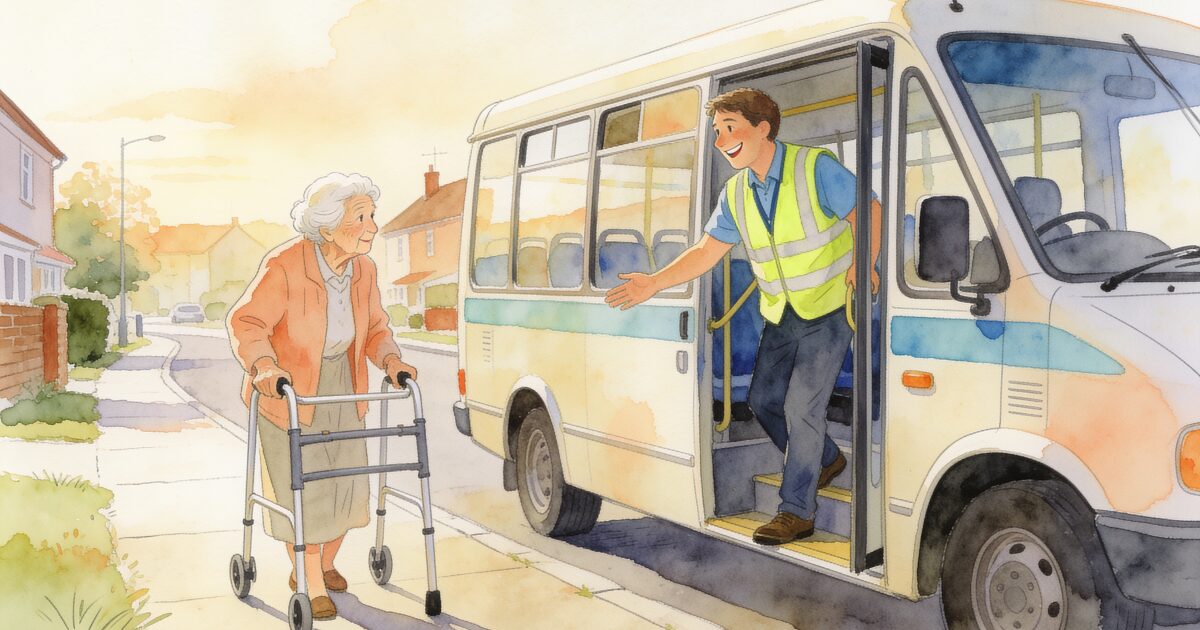
The car is more than a car. For most older adults it is the difference between choosing their day and waiting for someone else to have time. So when driving gets harder, whether that means handing over the keys or just avoiding highways and night driving, the question underneath is not really about transport. It is about staying in charge of your own life.
The call that never comes is the scariest. AssureOkay ensures someone always knows.
Try free for 3 daysThe good news is that there are more options than most families realise, and very few people need all of them. A parent who still drives locally may only need a plan for the hospital run. Someone who has stopped altogether will want a mix: a regular ride for the weekly shop, a service for appointments, and a way to say yes when a friend suggests lunch.
This guide walks through every option in plain terms, from family rotas and reduced-fare buses to paratransit, volunteer drivers, and ride-hailing apps you can set up from your own phone, then covers the safety details that keep a trip dignified.
The moment driving changes
Driving rarely ends on a single day. More often it narrows: no more nights, then no more freeways, then only the familiar loop to the supermarket and back. Each step is a loss, and it helps to name it that way rather than pretending it is purely practical.
If you are the adult child, start the conversation before the crisis, and start with what they want to keep doing rather than what they should stop. "How will you get to bridge on Thursdays?" is a better opening than "You should not be driving." Our guide to caring for elderly parents who live alone has more on holding hard conversations kindly.
Then build the plan around the real trips. Write down a typical two weeks: appointments, groceries, pharmacy, faith services, social visits, the hairdresser. Each one has a best option.
Family and friends, with a shared calendar
For most people, family and friends are the first and warmest option. The failure mode is not unwillingness. It is coordination: three people who would all happily drive on Tuesday, and nobody who knew the appointment existed.
A shared calendar solves most of it. Put every recurring trip on one calendar the whole family can see, assign a name to each, and leave a note when a ride is covered. Add a neighbour or two who have offered, and take them up on it for short local trips so the longer ones do not all fall on one person. Agree who owns the calendar so it does not quietly become nobody's job.
Keep it fair on your parent, too. Nobody enjoys feeling like a taxi booking. Where you can, tie the ride to something shared, such as coffee after the appointment, so it feels like a visit rather than a favour.
Public transport, reduced fares, and travel training
Buses and trains are the cheapest option by far, and in towns and cities with decent service they are often the most freeing, because nobody has to be asked.
Most US transit agencies offer reduced fares for older riders, often around half price, usually with a senior fare card or proof of age. Ask the agency how to apply, because the discount is rarely automatic.
If your parent has not used the bus in decades, look for a travel training programme. Many transit agencies and Area Agencies on Aging run them: a trainer rides along on real routes, shows how fares and stops work, and builds confidence over a few trips. For someone who has always driven, it can be the difference between using the bus and never trying.
The honest limits are weather, the walk to the stop, and the step onto the vehicle. If the nearest stop is a fifteen-minute walk uphill, the bus is a fair-weather option only.
Paratransit: door-to-door when the bus is not an option
Paratransit is the service most families have never heard of and most need to know about. In the US, under the Americans with Disabilities Act, public transit agencies that run regular bus or rail service must also provide a door-to-door or kerb-to-kerb service for people whose disability or condition stops them using the regular buses. It typically covers a similar area and similar hours to the regular routes.
You apply for eligibility, usually with a form, sometimes an interview or assessment, and often a note from a doctor or therapist explaining why the regular bus is not workable. Eligibility can be unconditional, conditional (only in winter, say, or only for certain trips), or temporary after surgery. Approval commonly takes a few weeks.
Once approved, rides are booked in advance, usually by the day before, and shared with other passengers, so pickup windows are wide and the trip takes longer than a taxi would. Fares are modest and set relative to the regular bus fare. Vehicles are accessible, and drivers are used to walkers and wheelchairs.
The trade-off is time and flexibility: superb for regular, planned trips, frustrating for spontaneous ones. Ask about the pickup window, the no-show policy, and how return trips are handled, because these vary by agency.
3-day free trial • Cancel anytime
Daily check-ins that save lives
Join thousands who never worry about being alone
Volunteer driver programmes
Some of the kindest rides come from neighbours. Volunteer driver programmes match older adults with vetted volunteers who drive their own cars, often waiting during the appointment and helping with the shopping bags afterwards. They are commonly run by councils on aging, senior centres, faith groups, and local charities, and rides are usually free or by donation.
Finding them takes a phone call rather than a web search, because many have no online presence at all. Your local Area Agency on Aging (reachable through the national Eldercare Locator service) is the best starting point, followed by the senior centre and your parent's own church, synagogue, or mosque.
The limits are lead time and capacity. Volunteers are volunteers, so a week's notice is common and popular slots go first. Treat them as a valued option for planned trips, not a same-day fallback.
Ride-hailing, set up for a parent
Uber and Lyft have quietly become one of the most useful tools for families, because a ride can be ordered from a phone in another city and watched all the way to the door.
Both apps let you request a ride for someone else from your own account: you set the pickup and destination, add their name and phone number, and they receive text messages with the driver's details and arrival time. Both also have family or shared-profile features that let you add a parent so you can see and pay for their trips; the exact shape of those features changes over time, so check the current version of the app. Some cities offer drivers trained to assist people with mobility needs, and wheelchair-accessible vehicles, though availability varies a great deal.
If your parent does not use a smartphone, services such as GoGoGrandparent let older adults order an Uber or Lyft by ordinary phone call, with operators who monitor the ride and can update family, for a fee on top of the fare. Check what is available in your area, because these services do not cover every location.
Ride-hailing suits people who can walk to the kerb and travel unassisted. It is fast and needs no booking ahead, but it is priced per trip, which adds up if it becomes the daily option. Agree a rule that your parent never gets into a car whose details do not match the text, and make sure they know how to call you if something feels off.
Taxis, account cards, and community shuttles
Old-fashioned taxis still deserve a place. Many local firms will set up an account for a regular customer, so a parent can call the same number every time, be recognised by the dispatcher, and have the bill go to a family member's card. Some cities and counties run taxi voucher schemes for older residents, which can cut the cost sharply; ask the Area Agency on Aging.
Community shuttles and senior centre buses are the local workhorses. Many senior centres run a minibus to their own activities, and some run scheduled shopping trips on set days. They are cheap or free, sociable, and slow, and they fit well alongside a more flexible option for everything else.
Medical trips: NEMT and insurance transport benefits
Medical appointments are the trips families worry about most, and they have their own system. Non-emergency medical transportation, or NEMT, is pre-arranged transport to and from healthcare for people who cannot get there otherwise. Medicaid covers it as a required benefit in every state for people with no other means, usually booked through a broker several days ahead. Traditional Medicare generally does not cover routine rides, but many Medicare Advantage plans include a transportation benefit, often a set number of rides per year.
It is a big enough topic for its own guide. Our deep dive on non-emergency medical transportation covers Medicaid brokers, Advantage benefits, PACE programmes, and how to book so the return trip does not get dropped.
Transport you can avoid altogether
Some of the best transport planning removes the trip. Grocery delivery, pharmacy delivery or mail-order prescriptions, and telehealth for routine follow-ups can take three or four trips a week off the list, leaving the remaining rides for things worth leaving the house for. Set up a repeating grocery order a family member can edit remotely, and ask the pharmacy about delivery or ninety-day supplies. Every trip avoided is one less thing that depends on a driver turning up.
Outside the US: the UK and Canada in brief
The shape of the problem is the same everywhere; the names change. In the UK, older people qualify for a bus pass giving free off-peak travel, and most areas have community transport schemes and dial-a-ride services offering door-to-door minibus trips for people who cannot use ordinary buses, usually booked a day or more ahead through the local council or a charity. In Canada, seniors' transit discounts are common and most cities run a specialised door-to-door transit service under a local name, with an eligibility application much like US paratransit. Everywhere, the local council or municipality and the nearest seniors' organisation are the best first calls.
Comparing the options at a glance
| Option | Cost model | Booking lead time | Door-to-door? | Best for |
|---|---|---|---|---|
| Family and friends | Free (fuel and goodwill) | Whenever agreed | Yes | Regular trips where company helps |
| Public transit with senior fare | Low fare per trip | None | No | Fit, confident riders in well-served areas |
| Paratransit (ADA) | Modest set fare | Usually the day before | Yes, or kerb-to-kerb | Planned trips for people who cannot use the bus |
| Volunteer driver programme | Free or donation | Often a week | Often door-through-door | Appointments needing patience and a hand |
| Ride-hailing (Uber, Lyft) | Per trip, market rate | Minutes | Kerb-to-kerb | Spontaneous trips, booked by family remotely |
| Taxi with account | Per trip, metered | Minutes to hours | Kerb-to-kerb | One familiar number to call |
| Community shuttle or senior centre bus | Free or low | Set schedule | Usually | Shopping trips and centre activities |
| NEMT or insurance ride benefit | Covered by Medicaid or the plan | Several days | Yes | Medical appointments only |
Safety and dignity on every trip
The practicalities of getting in and out of a car are where a good plan falls down, so they deserve a moment.
- Getting in and out. Sit first, then swing the legs in; the reverse to get out. A swivel cushion helps stiff hips, and a handle that hooks into the door latch gives something solid to pull on. Ask drivers to pull up on the flat, not a slope.
- Mobility aids. A folding walker goes in the trunk or across the back seat; make sure the driver knows to expect it. Our guide to the best walkers for seniors covers which fold smallest. A cane stays beside the person, not in the trunk; our guide on how to use a cane covers getting in and out of vehicles safely.
- Tell someone the plan. For every trip, one other person should know the destination, the rough return time, and who is driving. A text that says "in the car, home by three" is enough.
- Carry the essentials. A charged phone, a card with name, address, an emergency contact and any conditions, and a little cash for a taxi if the plan falls apart.
- If a ride does not show. Wait inside where it is warm, call the provider first, then a family member. Agree in advance who the fallback is and whether a taxi on the family account is fine, so nobody is left stranded and deciding.
A one-page ride sheet by the phone, with every provider's number, membership IDs, and the fallback plan, makes all of this easier for whoever is helping that week. Our aging in place checklist has a place for it alongside the other home essentials.
Knowing they got home
Everything above gets your parent to the appointment, the shop, or the friend's house. The last worry is the one no ride service solves: did they get home, and are they okay tonight? A shared van running late and a phone on silent can turn an ordinary Tuesday into an hour of watching the clock from another city.
A daily check-in closes that loop. Your parent confirms they are okay each day with one tap, a text reply, or by answering a short automated phone call that works on any phone, including a landline. If they ever miss it, you and the other people they chose are alerted automatically, with their last shared location if they allow it.
It does not book the rides. It just means that after every trip, the people who love them know they are home. You can set up daily check-ins for a parent from your own account in a few minutes.
Get the free Living Alone Safety Checklist
The home setup, daily habits, and emergency info that keep people living alone safe, in one email you can act on this week.
Please complete the verification above.
Check your inbox
Your safety checklist is on the way to .
Frequently asked questions
TRUSTED BY THOUSANDS OF FAMILIES
Never Wonder "Are They Okay?" Again
Daily check-ins with automatic alerts to your loved ones if you ever need help.
"I was skeptical at first, but after my neighbor was found 3 days after a fall, I signed up immediately. Now my daughter knows I'm okay every single day."
— Margaret R., 72, living independently
Related Articles
Exercises for Seniors: The Complete Guide by Goal (Balance, Strength, Heart, Flexibility)
The best exercise for an older adult depends on what you want from it. This guide sorts our exercise...
Walking for Seniors: How Far, How Often, and How to Stay Safe Walking Alone
Walking is the exercise most older adults actually keep doing. Here is how to start, how far and how...
Hearing Aids for Seniors: OTC vs Prescription, Real Costs, and How to Choose
Over-the-counter or prescription? Behind the ear or nearly invisible? Here is a plain guide to heari...
Best Walkers for Seniors in 2026: Rollators, Standard Walkers, Upright Walkers, and How to Choose
A walker that fits the person and the way they move keeps them walking for years longer. Here is a p...