Best Walkers for Seniors in 2026: Rollators, Standard Walkers, Upright Walkers, and How to Choose
Published September 24, 2026
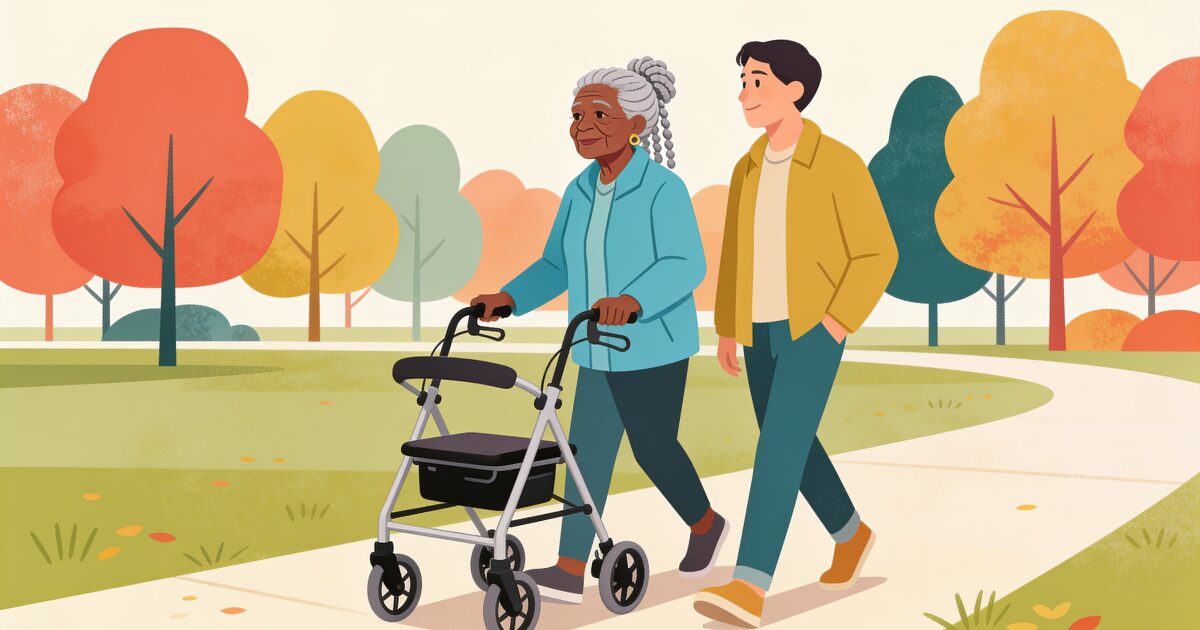
A walker is a bigger decision than it looks. The wrong one sits folded in a hallway because it is too heavy to get in the car, or too wide for the bathroom door, or because it rolls away when the person leans on it. The right one quietly restores walks to the shops, trips out with family, and the confidence to stand in a queue without fear.
Your family worries about you. Let them know you're okay every day.
Try free for 3 daysThere is no single best walker. There is the best walker for one person's legs, hands, home, and the kind of walking they actually want to do.
This guide explains the main types and who each suits, the features that matter, how to fit one to the right height, how to use it safely, and how to go about getting one. Where we name brands, we do so to give you a starting point, not a verdict.
The main types of walker
Standard and folding walkers (no wheels)
The classic frame with four rubber-tipped legs. You lift it, place it a step ahead, and walk into it. Because it stays put when you lean on it, this is the type for anyone who needs to bear real weight through their arms, for example after a hip or knee operation, or with significant weakness on one side.
The trade-off is pace. Lifting a frame with every step is slow and tiring, and it is awkward on anything but a flat surface. Most fold flat for storage and travel.
Two-wheel walkers
The same frame with wheels on the two front legs and rubber tips or glides at the back. You push it forward without lifting, and the back legs stop it running away. It is a sensible middle step for someone who needs solid support but finds lifting a standard frame too tiring, and it works well indoors.
Three-wheel rollators
A triangular frame on three wheels with hand brakes, and usually a small bag but no seat. The narrow front makes it the most manoeuvrable rollator in tight spaces and doorways, and it is the lightest to lift. It is less stable than a four-wheel model and cannot be sat on, so it suits people who are fairly steady and mainly want something to guide them and carry shopping.
Four-wheel rollators with seat and brakes
The type most people picture when they say "rollator". Four wheels, two loop-handle brakes that squeeze to slow and push down to lock, a padded seat between the handles, and a basket or bag underneath. Brands such as Drive Medical, NOVA, Medline and Hugo in the US, and Topro and Days in the UK, all make widely used models.
A four-wheel rollator supports balance and confidence rather than body weight. Because it rolls, you cannot lean hard on it. What it gives in return is walking at something close to a normal pace, over longer distances, with a seat to rest on whenever stamina, breath or pain calls for it. For someone whose problem is balance, endurance or fear of falling rather than a leg that cannot take weight, it is usually the right answer.
Upright (stand-up) rollators
A newer variation with tall frames and padded forearm rests instead of hand grips, so you stand upright with your elbows bent rather than stooping forward over the handles. UPWalker is the best-known name, and several other brands now make similar designs.
Standing taller is better for the back, the neck, breathing and eye contact, and people who hunch over a normal rollator often find it far more comfortable. The trade-offs are weight, bulk and price. Upright walkers are heavier and harder to fold into a car, take up more room indoors, and are not the right choice for someone who needs to put a lot of weight through their arms.
Knee walkers and hemi walkers, briefly
A knee walker (or knee scooter) is a wheeled platform you rest one bent knee on while pushing with the other foot. It is for temporary recovery from a foot or ankle injury, not for general mobility. A hemi walker is a one-handed frame, wider than a cane and narrower than a full walker, for people who can only use one arm, often after a stroke. Both are specialist items best chosen with a physiotherapist.
Bearing weight or keeping pace: the question that decides it
Almost every choice comes down to one question. Does this person need to put weight through their arms to stay upright, or do they need something to steady them and let them keep walking at a reasonable pace?
If they need to bear weight, a standard or two-wheel walker is the safe choice, because it will not roll away under them. If they need steadiness, confidence, a place to rest, and the ability to walk further, a rollator wins, because a frame they must lift will wear them out long before they reach the shops.
3-day free trial • Cancel anytime
Daily check-ins that save lives
Join thousands who never worry about being alone
Walker types at a glance
| Type | Best for | Seat | Outdoor use | Frame weight |
|---|---|---|---|---|
| Standard walker (no wheels) | Bearing weight after surgery or with weakness | No | Poor | Light |
| Two-wheel walker | Solid support without lifting, mostly indoors | No | Poor to fair | Light |
| Three-wheel rollator | Tight spaces, steady walkers who want a guide | No | Fair | Light |
| Four-wheel rollator | Balance, stamina, resting on longer walks | Yes | Good, better with larger wheels | Medium |
| Upright rollator | People who stoop, back or neck strain | Usually | Good | Medium to heavy |
| Knee walker | Temporary foot or ankle recovery | Knee platform | Fair | Medium |
| Hemi walker | One-handed use, often after a stroke | No | Poor | Light |
Features worth paying attention to
- Seat. Only on rollators. Check the seat height suits the person: too low and they will struggle to stand, too high and their feet will dangle. A backrest strap makes resting more comfortable.
- Brakes. Loop brakes that squeeze to slow and push down to lock are the norm. Make sure the person's hands are strong enough to work them, and that the brakes can be adjusted as the cables stretch.
- Wheel size. Small wheels are fine on smooth floors. For pavements, gravel paths and kerbs, larger wheels roll over bumps instead of stopping dead, and are worth choosing for anyone who will walk outdoors.
- Weight of the frame. A lighter frame is easier to lift into a car boot or up a step, but very light frames can feel flimsy. If the person will lift it themselves, weigh that carefully.
- Folding. Check how it folds, how small it goes, and whether it stays folded on its own. Some fold sideways and stand up folded, which is much easier in a car or a narrow hallway.
- Height adjustment. Almost all are adjustable, but check the range covers the person, especially if they are very tall or very short.
- Weight capacity. Every walker has a maximum user weight. Bariatric models with wider, reinforced frames and higher capacities are available from most of the main brands, and it is important to choose one if it is needed.
- Width. Measure the narrowest doorway the walker will need to pass through, usually the bathroom, before buying anything.
Fitting the height correctly
A walker at the wrong height is uncomfortable at best and unsafe at worst. Too high and the shoulders hunch and the arms cannot take weight properly. Too low and the person stoops, which throws their balance forward.
To check the fit, stand upright in the shoes you usually walk in, with your arms relaxed at your sides. The top of the handles should line up with the crease of your wrist. When you take hold of the handles, your elbows should be slightly bent, roughly fifteen to twenty degrees, and your shoulders relaxed.
It is the same principle as fitting a cane, and our guide to how to use a cane correctly explains it in more detail. For an upright walker, the forearm rests should sit so that you stand tall with your elbows at about a right angle, without leaning forward or lifting your shoulders.
Re-check the height if you change footwear, and have someone look at your posture from the side once you are moving.
Using a walker safely
- Do not pull yourself up on it. A walker, and especially a rollator, is not an anchor. Stand up by pushing on the arms of the chair or bed, then take hold of the walker once you are steady on your feet.
- Sit only with the brakes locked. Before sitting on a rollator seat, push both brakes down to lock them, and check the walker does not move. Release them only after you are standing again.
- Stay inside the frame. Walk into the walker so that you are between the back wheels or legs, not trailing behind it with your arms outstretched.
- Turn in small steps. Move your feet round with the walker rather than twisting your body while your feet stay planted. Twisting is how many falls with walkers begin.
- Take kerbs and steps square on, and slowly. With a rollator, brake, tip the front wheels up onto the kerb, then bring the back wheels up. Use a ramp or a different route where you can.
- Keep the basket light. Heavy shopping in a front basket makes a rollator tip forward. Put weight low and central.
- Check the tips and brakes regularly. Worn rubber tips slip, and stretched brake cables stop holding.
Legs do the real work of staying upright, and a walker supports them rather than replacing them. A few minutes of leg exercises for seniors and balance exercises most days keeps the walker as a helper rather than a crutch.
Indoors versus outdoors
Many people end up with two walkers, or accept a compromise, because the demands of a home and a pavement are so different.
Indoors, the priorities are width, turning circle and not marking the floors. A narrow two-wheel walker or a three-wheel rollator gets through doorways and turns in a small kitchen. Loose rugs, thresholds and trailing cables need dealing with, and our fall prevention tips for people living alone cover that.
Outdoors, the priorities are wheel size, stability and a seat. A four-wheel rollator with larger wheels handles uneven pavements, and the seat turns a daunting walk into a series of short ones with rests. Our guide to walking for seniors covers building up distance gently once you have the right support. If the walker will regularly go in a car, how it folds and how much it weighs matter as much as anything.
How to get one
Start with an assessment rather than a shopping basket. A physiotherapist or occupational therapist will look at how the person walks, what they can bear weight on, their grip strength and their home, and recommend a type and a height. It is the single most useful step, and it often avoids an expensive mistake.
In the US, Medicare Part B generally covers a basic walker or rollator as durable medical equipment when a doctor prescribes it as medically necessary and you buy or rent from an enrolled supplier, subject to the usual deductible and cost-sharing. Private insurance and Medicaid vary, so ask before buying. Upright walkers and premium models are often not covered or only partly covered.
In the UK, an NHS physiotherapist or occupational therapist can often provide a standard walking frame on loan after an assessment, and community equipment services in many areas lend basic aids. Rollators are more often bought privately, but charities such as the British Red Cross, local Age UK branches and independent living centres run loan and low-cost schemes, and some mobility shops sell reconditioned models. Wherever you are, it is worth asking about a trial period before committing.
A walker steadies every step. It cannot call for help.
Chosen and fitted well, a walker cuts the risk of a fall, brings back walks that had stopped, and adds years of getting about independently.
But a walker shares a limitation with every mobility aid. It helps prevent the fall. It cannot do anything once one has happened, and for someone who lives alone, the danger is rarely the fall itself but the hours afterwards if nobody knows.
A daily check-in fills that gap. Each day the person confirms they are okay with a tap on the phone they already have, a reply to a text, or by answering a short automated call. If they do not, the people they have chosen are alerted so someone can look in on them. See how a daily check-in works, and pair the right walker with someone who will notice.
Get the free Living Alone Safety Checklist
The home setup, daily habits, and emergency info that keep people living alone safe, in one email you can act on this week.
Please complete the verification above.
Check your inbox
Your safety checklist is on the way to .
Frequently asked questions
TRUSTED BY THOUSANDS OF FAMILIES
Never Wonder "Are They Okay?" Again
Daily check-ins with automatic alerts to your loved ones if you ever need help.
"I was skeptical at first, but after my neighbor was found 3 days after a fall, I signed up immediately. Now my daughter knows I'm okay every single day."
— Margaret R., 72, living independently
Related Articles
Chair Yoga for Seniors: 10 Seated Poses for Flexibility, Balance, and Calm
You do not need to get down to the floor to enjoy yoga. These 10 seated poses bring the stretch, ste...
Yoga for Seniors: Benefits, Best Styles, and How to Start
Yoga is one of the kindest ways for older adults to build flexibility, balance, and calm. Here's wha...
Best Vitamins for Seniors: The Key Nutrients That Matter With Age
Our nutritional needs shift as we get older. Here are the key vitamins and minerals that matter most...
Vitamin B12 for Seniors: Why It Matters and How to Get Enough
B12 keeps your nerves, blood, and memory working well, yet older adults often absorb it poorly. Here...