Living Alone With Dementia: When It Is Still Safe, and What Changes That
Published October 9, 2026
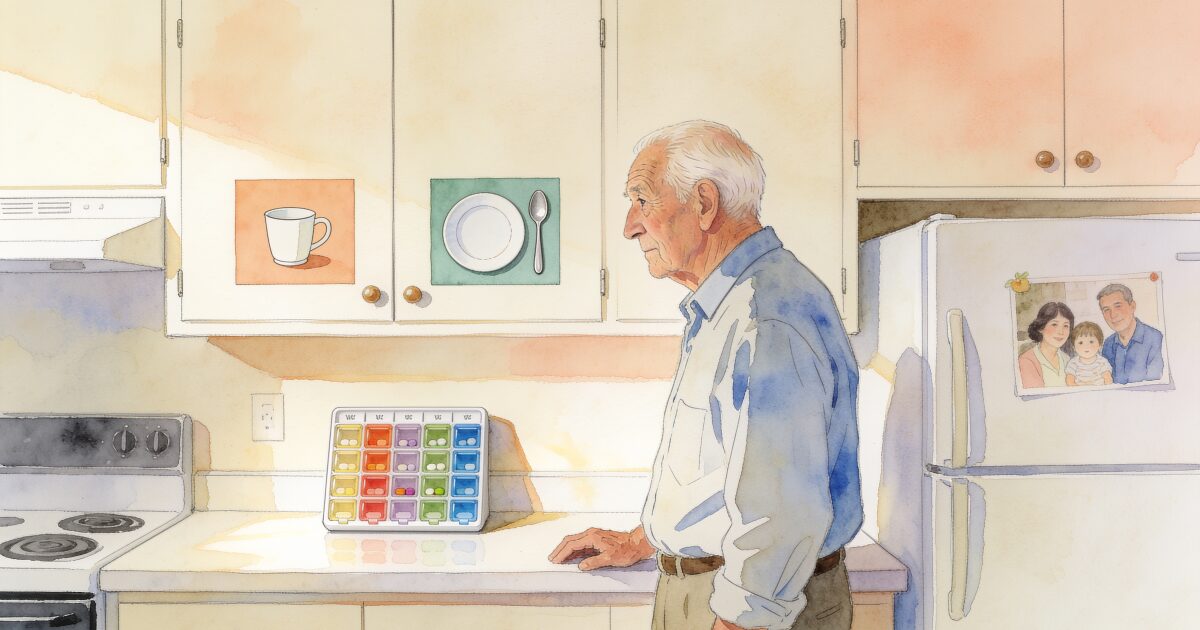
If you are reading this, you have probably had the moment. A pan left on the stove. A missed appointment. A phone call where your mother told you the same story twice and did not notice. And underneath it, the question that does not go away: is it still safe for her to live on her own?
Peace of mind for under /month. Automatic alerts if you ever need help.
Try free for 3 daysThe honest answer is that it depends, and that it changes. Many people with early-stage dementia live alone for years, with the right support around them. Others reach a point, sometimes quickly, where living alone stops being safe and no amount of technology or good intention changes that.
This guide is for the family member trying to judge where on that line a parent sits today. It covers what "safe enough" looks like, the signs the balance is shifting, the supports that stretch independence, what technology can and cannot do, the legal side to sort while capacity remains, how to have the conversation with dignity, and how to look after yourself.
Many people with dementia do live alone, and for years
A dementia diagnosis is not, by itself, a reason to move someone out of their home. In the early stages, many people manage well. They know their own kitchen, their own street, their own routine. Familiar surroundings are one of the strongest supports a person with dementia has, and moving them can cause a sharp decline in the very abilities you are trying to protect.
What changes is the margin for error. A person without memory problems who forgets the stove turns it off when they smell it. A person with dementia may not connect the smell to the stove. The home does not become more dangerous; the ability to recover from small mistakes shrinks.
So the goal, for as long as possible, is not "no risk". It is risk that is managed, watched, and low enough. That is a judgement, not a formula, and it needs revisiting every few months.
What "safe enough" looks like
Families often get stuck asking "can Mum still cope?", which is too vague to answer. It helps to break it into the handful of things that actually matter for someone living alone with dementia:
- Medication is being taken correctly. Not roughly. Correctly. Missed doses and doubled doses are among the most common ways early dementia becomes a hospital admission.
- They are eating and drinking enough. Food in the fridge that is being eaten, not just bought. Weight stable. No sign of dehydration, which can worsen confusion dramatically.
- They are not wandering or getting lost. Still finding the way home from familiar places. Not leaving the house at night. Not opening the door to anyone who knocks.
- Fire and scald risks are managed. The stove, the kettle, candles, the heater. Either they use them safely or the risk has been engineered out.
- They can summon help, and would. They know how to call someone, would recognise that they need to, and can operate whatever they would use to do it.
- Someone would notice quickly if something were wrong. Not within a week. Within a day.
If those six are true, living alone is often still reasonable. If two or three are slipping, the picture is changing.
A green, amber, red way to see it
Some families find it useful to think in traffic lights. This is not a clinical tool, just a way to talk about the same thing without arguing about labels.
- Green: managing with light support. Medication in a dispenser and taken. Eating normally. Keeping appointments with reminders. Occasional repeated stories and misplaced items, but no safety incidents. A daily call answered as normal.
- Amber: managing with substantial support, and watching closely. A missed dose or two a month despite the dispenser. Food going off in the fridge. A near miss with the stove. Confusion about the day or time. This is the stage to add supports fast and start planning the next step, not to wait.
- Red: no longer safe alone. Leaving the house and getting lost. A fire, a scald, or a fall with no way to call. Not eating. Letting strangers in or giving out bank details. Not recognising the need for help. Night-time confusion or distress. At this point more gadgets are not the answer, and the conversation becomes about where, and with whom, they live next.
Most people move through these slowly, but an infection, a hospital stay, or a bereavement can push someone from green to red in weeks. Our guide to the signs your aging parent should not live alone any more goes deeper on what to look for across every kind of decline, not just dementia.
Warning signs the balance is shifting
Beyond the traffic lights, a few specific signs tend to appear before a crisis, and each is easy to explain away on its own. Scorch marks on pans, or a smoke alarm taken down "because it kept going off". Unopened post and unpaid bills, or the same bill paid three times. Weight loss you can see. New bruises with vague explanations. The same clothes worn several days running. A neighbour mentioning they saw your father out at an odd hour. Phone calls at 3am asking what day it is. A sudden new "friend" who helps with the shopping and has access to the bank card.
None of these is proof of anything by itself. A cluster of them, or a sudden change, is a signal to see the doctor, review the support in place, and have the conversation you have been putting off.
Practical supports that extend independence
The good news is that a lot of ordinary, unglamorous changes buy real time at home. Most of them work by taking the memory out of the task.
- A rock-solid routine. Same wake time, same meal times, same daily call at the same hour. Routine is the scaffolding that holds a day together when memory does not. Change as little as possible about the home itself.
- Labels and open shelving. Pictures or words on cupboard doors, the kettle and the mugs always in the same place. Remove duplicates that cause confusion.
- An automatic pill dispenser. Locked units that release the right dose at the right time and sound until it is taken are one of the highest-value purchases you can make. Some alert a family member if a dose is missed.
- Stove shut-off devices and safer kitchen kit. Devices that turn the cooker off after a period with no motion nearby are widely available. A kettle that switches itself off and a microwave for reheating both lower the fire risk.
- A simplified phone. A handset with a few large photo buttons, or a smartphone stripped back to calls and one or two contacts, is far more likely to be used in a crisis than a phone full of apps. Our guide to cell phones for seniors covers the options, including the very simple ones.
- A key safe. A coded box by the door means a neighbour, a carer, or an ambulance crew can get in without breaking anything, and without your parent having to remember where the spare key went.
- A daily check-in by call. One phone call at the same time every day, which your parent answers to confirm they are okay. It structures the day, catches a problem within hours rather than days, and, because it is a call rather than an app, it suits a person who will never learn a new interface.
Regular human visits belong alongside all of this. Eyes on the person, on the fridge, and on the smell of the kitchen tell you things no sensor does.
Technology that helps, and where it stops
Technology can extend independence considerably. It can also give families a false sense of security, so it is worth being clear-eyed about what each thing does.
Monitoring systems, from door sensors to whole-home motion systems, tell you about patterns: the kettle boiled at seven, the front door opened at 2am, nobody moved in the kitchen all day. They are excellent for spotting change and poor at telling you why. Our overview of elderly monitoring systems covers what is available and what each actually does.
3-day free trial • Cancel anytime
A daily phone call your parent simply answers
AssureOkay calls your parent at the same time each day. They confirm they are okay by answering, with nothing to learn and no app to manage. If the call goes unanswered, you and the family are alerted automatically. It works on any phone, including a landline.
GPS trackers, worn as a pendant or watch or slipped into a bag or shoe, matter most once wandering becomes a risk. They can find a lost person quickly. They cannot stop them leaving, and they only work if the device is on the person and charged, both of which get harder as dementia progresses. Our guide to GPS trackers for the elderly goes through the trade-offs, including the question of consent.
Pendant alarms and fall detectors are only as good as the person's ability to press them, or to remember to wear them. In the middle and later stages of dementia, that is precisely what fails.
The common thread: technology works best when it does not require the person with dementia to do anything new. Things that happen to them (a call that arrives, a dispenser that sounds, a stove that turns itself off) last far longer than things they must learn to operate. And no technology replaces the judgement of a person who sees them regularly. It shrinks the gaps between visits; it does not remove the need for them.
The legal and money side, while capacity remains
This is the part with a deadline, and the deadline is invisible.
While your parent can still understand and make decisions, they can appoint someone they trust to act for them if they later cannot. In the US this is typically a durable power of attorney for finances and a health care proxy. In the UK it is a lasting power of attorney for property and financial affairs and another for health and welfare. Other countries have equivalents. Alongside these sit a will and, ideally, an advance statement of what care they would and would not want.
Once capacity is lost, these documents cannot be made. The alternative is a court process (guardianship or conservatorship in the US, a deputyship in the UK) that is slower, more expensive, and gives your parent no say in who is chosen. Do this early, with a lawyer who works in elder law, while your parent is having a good stretch.
Money needs watching too. People with dementia are a favourite target for scams and for "helpful" acquaintances. Alerts on accounts, bills on automatic payment, and gently taking over the paperwork as it becomes stressful for them can prevent a great deal of harm.
How to have the conversation with dignity
Nobody wants to be told they cannot cope. Your parent may have spent a lifetime as the competent one, and dementia is already taking things from them. The way you talk about support matters enormously.
Start with what they want, which is almost always to stay in their own home, and frame every change as a way of achieving that. "This dispenser means you can stay here safely" lands very differently from "you keep forgetting your pills".
Bring one change at a time, and where you can, let them choose between options rather than accept or refuse a single one. Involve their doctor, whose word may carry weight yours does not. Never argue about memory in the moment; correcting someone with dementia wins nothing and costs trust.
And be honest with yourself about the destination. Living alone with dementia is a stage, not a permanent state. The supports in this guide extend it; they do not make it indefinite, and at some point the kindest thing will be a change you both find hard. Having talked early about what that might look like, while your parent could still shape it, is the most dignified path there is.
Caring for yourself too
Supporting a parent who is living alone with dementia is exhausting in a particular way. The worry is constant, the phone is never quite off, and every quiet day is both a relief and a source of low-level dread. From a distance, add the guilt of not being there and the cost of travelling every time something goes wrong.
You are allowed to find this hard, and you will do it better and for longer if you protect yourself. Share the load with siblings, however imperfectly. Accept paid help before you are desperate. Take the holiday, and put your own appointments in the diary. Our guides to caregiver burnout and long-distance caregiving are written for exactly this stretch.
A daily call that fits a familiar routine
Every support in this guide shares one gap: on any given morning, if something went wrong, how long before anyone knew? Sensors report patterns, not problems. Pendants need pressing. Your own calls depend on you being free, and on a parent who may not answer because they did not hear it rather than because anything is wrong.
A daily automated phone call closes that gap in a way that suits dementia. The call comes at the same time every day, so it becomes part of the routine rather than an interruption, and the voice quickly becomes a familiar one. Your parent simply answers, as they would any call, and confirms they are okay. Nothing to learn, no app, no charger; it works on the landline they have used for forty years. If the call goes unanswered, you and the rest of the family are alerted automatically so someone can check in person.
It does not replace your visits or your judgement. It means that on the days you cannot get through, a silence is noticed within hours rather than days. You can set up daily check-ins for a parent from your own account in a few minutes.
Get the free Living Alone Safety Checklist
The home setup, daily habits, and emergency info that keep people living alone safe, in one email you can act on this week.
Please complete the verification above.
Check your inbox
Your safety checklist is on the way to .
Frequently asked questions
TRUSTED BY THOUSANDS OF FAMILIES
A daily phone call your parent simply answers
AssureOkay calls your parent at the same time each day. They confirm they are okay by answering, with nothing to learn and no app to manage. If the call goes unanswered, you and the family are alerted automatically. It works on any phone, including a landline.
"I was skeptical at first, but after my neighbor was found 3 days after a fall, I signed up immediately. Now my daughter knows I'm okay every single day."
— Margaret R., 72, living independently
Related Articles
Living Alone: The Complete Guide to Doing It Well (Safety, Loneliness, Money, and Joy)
Millions of people live alone, and almost nobody teaches you how. Here is the honest version: the fi...
Solo Aging: What It Means and How to Plan for Growing Older on Your Own
Growing older without a partner or nearby children to fall back on is more common than the brochures...
The State of Living Alone in America: 2026 Report
38.3 million Americans now live alone, the most in history. This report compiles the latest Census d...
Safety Tips for Seniors Living Alone: A Room-by-Room Checklist
Living alone in later life should mean freedom, not fear. This room-by-room checklist covers the pra...