Living Alone: The Complete Guide to Doing It Well (Safety, Loneliness, Money, and Joy)
Published September 14, 2026
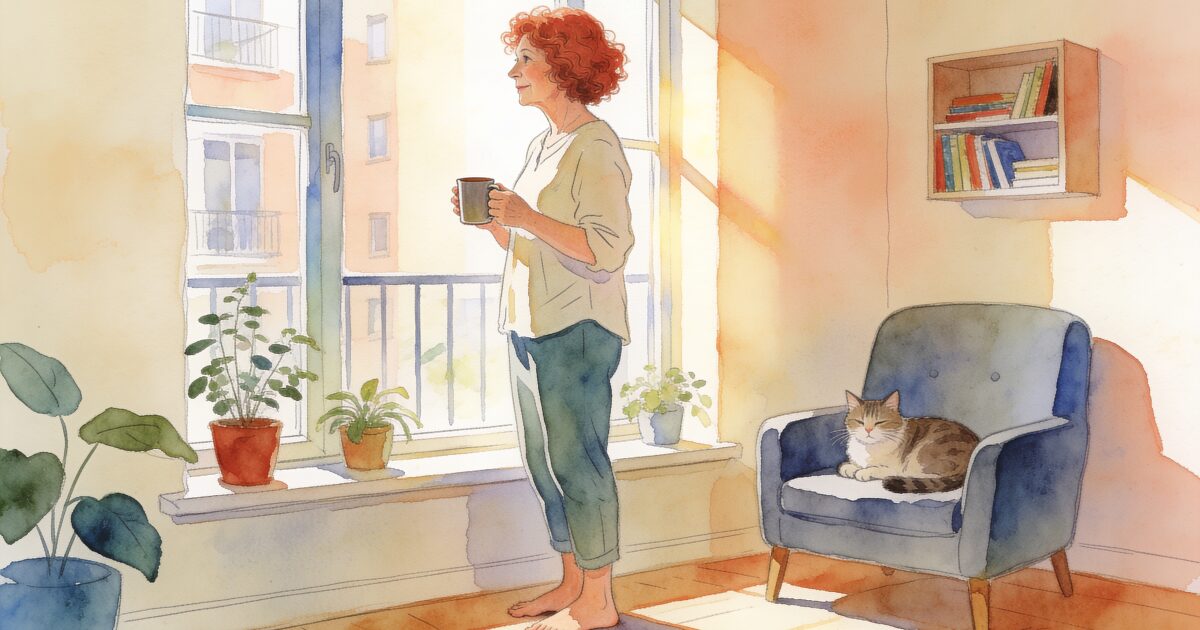
Somewhere around a third of the front doors on your street have one name behind them. Living alone is not a phase people pass through on the way to a "proper" household any more. For millions of people it is the household, and it has been for years.
Don't let distance keep you from knowing they're safe. Daily check-ins, anywhere in the world.
Try free for 3 daysAnd yet almost nobody teaches you how to do it. You learn by trial and error: the first night the boiler makes a noise you have never heard, the first time you cook a recipe that serves four and eat it for four days, the first Sunday that stretches out with nobody to fill it.
This guide is the one we wished we had. It covers the honest question of whether living alone is healthy, what the first months are like, the joys nobody mentions, loneliness (and how it differs from being alone), money on one income, living alone after 60 or after a loss, and the one subject that gets properly practical: staying safe when nobody else is home.
It is written for anyone doing this, whether you are 24 in a first studio flat or 81 with no intention of moving. The details differ. The craft is the same.
Living alone is normal now
If you have ever felt like the odd one out for coming home to an empty flat, the numbers should reassure you. In the US alone, around 38 million people live by themselves, close to three in ten households, and almost 16 million of those households are a single person aged 65 or older. We pulled the census figures together in our State of Living Alone 2026 report, and the wider picture across other countries is in our round-up of solo living statistics.
The point is not the numbers themselves. The point is that solo living is one of the most common ways to live, and the culture has not quite caught up. Recipes serve four. Holiday deals assume two. Your relatives still ask when you are going to "settle down", as if you were living in a tent. You are doing something very ordinary, without much of a manual.
Is it healthy to live alone?
Honest answer: it depends, and not on the thing most people assume.
The research on isolation and health is genuinely worrying. But isolation and living alone are not the same thing. Plenty of people live alone with a full calendar, a neighbour who knows their routine, and a sister they speak to every day. Plenty of people live in a busy house and feel entirely unseen.
What the studies actually measure is connection: how often you have meaningful contact, whether anyone would notice if you were unwell, whether you have people to call. Living alone makes those things easier to let slide, because nothing forces them. Nobody in the next room asks why you did not go out this week.
So the healthy version of living alone is deliberate. You build the contact that a shared household would give you by accident: standing arrangements, a weekly call, a neighbour you actually know, some kind of group you turn up to. The unhealthy version is drifting. The days blur, the phone stays quiet, and you slowly stop noticing that it does.
There is a second piece, which is practical rather than emotional. When you live with someone, they are your early-warning system. They notice when you look grey, when you did not come downstairs. Living alone means building that warning system on purpose. We come back to it later, because it is the part most guides skip.
Living alone for the first time
Whether you are 22 and just moved out, or 55 and living alone for the first time in thirty years, the first stretch has a shape.
The first month
The first week is often a strange mix of glee and unease. You can eat cereal for dinner. Nobody comments on how long you shower. You also hear every creak the building makes, and you may find yourself turning the television on for company rather than for anything on it.
Two things help enormously in the first month. The first is to set the place up properly rather than living out of boxes. A home that feels finished is easier to relax in, and arranging it is a small, satisfying way of saying: I live here now.
The second is to anchor the week. Pick two or three fixed points (a class, a call, a Saturday market, a standing coffee) and put them in before you feel the need. Loneliness rarely arrives in the first week. It arrives in week five, when the novelty has worn off and nothing is in the diary.
The quiet
The quiet is the thing people mention most, and it changes character over time. At first it can feel like an absence, a room that is missing a conversation. Somewhere along the line, for most people, it turns into a presence: the sound of a home that is entirely yours.
If it bothers you in the early days, do not feel you have to sit in it heroically. Radio, podcasts, and the sound of a cat rearranging things at 3am all count.
Cooking for one
Cooking for one is a genuine skill, and it is mostly about shopping, not cooking. Buy for three or four meals at a time, not a week. Learn five dinners you actually enjoy and can make with your eyes closed. Cook double and freeze half, so a bad day has a good meal waiting in it.
Eat at a table sometimes, on a plate, with the phone face down. Not every night. Just often enough that dinner does not become something you do standing at the counter.
Do you get used to living alone?
Yes. For most people the adjustment takes somewhere between a few weeks and a few months, and then one day you realise you have not thought about it for ages. You have your side of the bed (all of it). You have your way of doing things. Then you go and stay with family for a week and find yourself craving your own kitchen.
The people who do not get used to it usually have one of two problems: not enough contact, or a home that never came to feel like theirs. Both are fixable. Neither is a reason to think you are simply not cut out for solo living.
The joys nobody warns you about
Guides on how to live alone tend to be written as if it were a condition to be managed. So, for balance, some of what people who live alone will privately tell you they love.
Nobody moves your things. The scissors are where you left them. This sounds trivial until you have lived with a person who "tidies".
Your evenings are yours. There is no negotiation about what to watch, when to eat, whether to go out. You can go to bed at nine with a book and nobody raises an eyebrow. You can also stay up until two, unwisely, and answer to no one.
You get to know yourself. Living alone strips out a lot of the reactive noise of shared life and leaves you with your own preferences. Many people discover they are more sociable, or more introverted, or more organised, or considerably more relaxed than the version of them that existed in a busy house.
3-day free trial • Cancel anytime
Live alone, not unnoticed
AssureOkay checks in with you once a day by app, text, or a quick phone call. If you ever do not respond, the people you choose are alerted automatically. No hardware and no fuss, just someone who would notice.
And the great unspoken joy: you can dance in the kitchen, sing badly, talk to the plants, and eat the last of anything without a single witness.
Loneliness versus being alone
These are different things, and confusing them makes living alone harder than it needs to be.
Being alone is a state. You are in a room with no one else. It can be restful, productive, boring, or lovely, depending on the day.
Loneliness is a feeling: the gap between the connection you have and the connection you want. You can feel it in a crowded room or a busy marriage. You can be alone for a week and not feel it at all.
The practical upshot is that the fix for loneliness is not "stop living alone". The fix is more of the right kind of contact. Regular beats occasional. A standing Tuesday phone call with a friend does more than a big catch-up every three months. Being useful to someone (volunteering, helping a neighbour, being the person who organises the thing) is one of the most reliable cures, because it makes you needed.
It also helps to know that loneliness comes in waves, often at predictable times: Sunday evenings, holidays, the first cold week of autumn, the anniversary of something. If you can see the wave coming, you can put something in its path. We go deeper on this, including what to do when it stops feeling like a wave and starts feeling like the weather, in our guide to combating loneliness when you live alone.
Money and admin when there is one income
Here is the unglamorous truth: living alone is more expensive per person than sharing, and every bit of admin is yours.
Rent or a mortgage, utilities, internet, insurance, property or council tax, the streaming subscriptions: all of it lands on one salary or one pension. There is no housemate to split the broadband with and no partner to notice that the electricity bill has doubled. A few things make this far less stressful:
- One list of every recurring bill. Amount, date, and how it is paid. Put it somewhere you will see it. Half the anxiety of solo finances is not quite knowing what is going out.
- An emergency fund, even a small one. When the boiler dies, nobody else is paying half. Three months of essential costs is the usual advice; one month is far better than none.
- Automate the boring bits. Bills on direct debit or autopay, savings moved the day you are paid, and a calendar reminder for the annual renewals that quietly creep up in price.
- A second name who knows where things are. Not on your accounts necessarily, but someone who knows which bank you use, where the important documents live, and who your landlord or mortgage lender is. If you were in hospital for a fortnight, that person could stop things falling apart.
Admin is the same story. There is nobody to remind you the car registration is due or that the smoke alarm is chirping. Pick one day a month, make a cup of tea, and do the lot.
Living alone after 60, or after a loss
Many people who live alone did not choose it, or chose it late. A marriage ends. A partner of forty years dies. The children leave and the house that was full is suddenly not. If that is where you are, this section is for you, and it is written gently on purpose.
Living alone after 60 is extremely common and no reflection on you. Millions of older adults do it, most of them well, many by preference. It is still an adjustment, even when you saw it coming. Grief and solo living often arrive together, and it can be hard to tell which one is making the evenings long.
Tips for living alone after 60 that people who have done it tend to agree on:
- Keep the routine, change the parts that hurt. If Sunday lunch was a shared ritual, do not sit through a silent version of it. Eat out, invite someone, or make Sunday the day for something new entirely.
- Say yes for a year. Invitations dry up if they are declined. Accept more than you feel like accepting, at least for a while, and see what sticks.
- Let people in, literally. A neighbour who has a key and knows your habits is worth more than any gadget. So is a friend who pops round without needing an occasion.
- Notice if the house is running you. A big family home can become a full-time maintenance job for one person. Staying put with some adaptations, or moving somewhere smaller and easier, are both good answers. Our guide to solo aging walks through the housing and planning questions in detail.
- Watch for the slide from sad to stuck. Low mood after a loss is normal. Low mood that stops you eating, sleeping, or leaving the house for weeks is something to talk to your doctor about, and it responds to help.
If you are here because the children have gone rather than because a partner has, our post on empty nest syndrome is written for exactly that particular quiet.
Safety when no one else is home
This is the one section of this guide that gets properly practical, because it is the part of solo living that other guides tend to wave at and move past.
The safety difference between living alone and living with someone is not that you are more likely to have an accident. It is that if you do, nobody is there to notice. A fall in the bathroom, a bad reaction to a new medication, a stroke at 6am: in a shared house, someone finds you in minutes. Alone, the question is how many hours pass before anyone realises you have gone quiet.
So the goal of solo safety is twofold. Reduce the chance of the thing happening, and shrink the time between it happening and someone knowing. A short checklist:
- Keep the phone on you, not across the room. A pocket, a lanyard, a wrist. Many people who fall and cannot get up are within sight of a phone they cannot reach.
- Know how to call for help without your hands. A voice assistant, the emergency shortcut on your phone's side button, or a smartwatch with fall detection. Practise it once so it is not new in a crisis.
- Make the home boring to fall in. Good lighting on the route to the bathroom, no loose rugs, grab rails where you would grab anyway, non-slip mats, and nothing stored above head height. Our room-by-room safety checklist covers the whole house.
- Do not lock the bathroom door. Nobody is coming in. If you fell, a locked door would delay whoever comes to help.
- Have a plan for a fall. Read what to do if you fall and live alone before it happens, not after. Knowing how to get warm, get attention, and get up safely changes the outcome.
- Give someone your routine. One person who knows you are usually up by eight and always answer texts by lunch is the single most effective safety measure there is. A pattern only works if someone is watching for it to break.
- Know your emergency number and address cold. 911 in the US, 999 in the UK, 112 across much of Europe. In a real emergency, people forget their own postcode.
The medical side deserves its own note. Living alone is usually fine day to day, but a sudden illness is when it bites: nobody to drive you, nobody to notice you are confused, nobody to answer the doctor's questions. Our guide to what happens if you live alone and have a medical emergency is worth reading while you are well, and then acting on: a medical ID set up on your phone, a list of medications on the fridge, and a person who knows both.
A simple daily rhythm that makes solo life easier
Nobody living alone needs a rigid schedule. But a light rhythm, the same few things in roughly the same order, keeps the days from blurring, keeps you connected, and makes a break in the pattern visible to someone. Something like this:
- A proper morning. Up at a consistent time, curtains open, something to eat that is not just coffee. Getting dressed even when nobody will see you is oddly powerful.
- One check-in. A daily moment where someone knows you are okay: a text to a friend, a word with a neighbour, or a daily check-in app that asks you once and alerts your people if you do not answer. Done first thing, it takes seconds and covers the whole day.
- Some movement outdoors. A walk, the shops, the garden, the dog. Daylight and a change of scene do more for mood than most things you can buy.
- One human conversation. Not a message. A voice, in person or on the phone. It does not have to be long.
- A real meal, sat down. At least once a day. Standing at the counter does not count.
- An evening wind-down that is not just the television. A book, a bath, a call, a hobby with your hands. Sleep is easier when the day has an ending.
None of this is complicated. Living alone simply removes the external prompts (someone else getting up, someone else cooking) that make these things happen by themselves, so you supply the prompts.
Pets and living alone
A pet changes solo living more than almost anything else. Something is pleased to see you when you come in. Something needs feeding at seven, which means you are up at seven. A dog gets you outdoors twice a day and introduces you to every other dog owner in the neighbourhood, which is a social life you did not have to organise.
The honest trade-offs: cost, the difficulty of spontaneous travel, and the question nobody likes to think about. If something happened to you, who would feed the cat? A pet that depends on one person needs a backup person, and that person needs a key. Pets are also a trip hazard, especially small ones underfoot at night.
None of that is an argument against a pet. It is an argument for a small amount of planning, which we set out on our page about living alone with pets. For most people who live alone, the animal is worth every bit of it.
Someone who would notice
Everything in this guide comes back to one idea. Living alone works beautifully when it is chosen and connected, and it gets risky at exactly one point: when something goes wrong and nobody knows.
A good phone, a safe home, and a friendly neighbour all help. But each depends on you being able to reach out. The one thing a shared household gives you for free, and solo living does not, is someone who notices a silence.
A daily check-in fills that gap without making a fuss of it. Each day you confirm you are okay with one tap, a quick text reply, or by answering a short automated call that works on any phone, including a landline. If you ever do not respond, the people you have chosen are alerted automatically, with your last shared location if you want them to have it, so a quiet day is never mistaken for a normal one.
It takes a few seconds a day, and it means you can enjoy all the good parts of living alone with the one bad part quietly handled. If that sounds like the missing piece, you can see how the check-in app for people living alone works.
Get the free Living Alone Safety Checklist
The home setup, daily habits, and emergency info that keep people living alone safe, in one email you can act on this week.
Please complete the verification above.
Check your inbox
Your safety checklist is on the way to .
Frequently asked questions
TRUSTED BY THOUSANDS OF FAMILIES
Live alone, not unnoticed
AssureOkay checks in with you once a day by app, text, or a quick phone call. If you ever do not respond, the people you choose are alerted automatically. No hardware and no fuss, just someone who would notice.
"I was skeptical at first, but after my neighbor was found 3 days after a fall, I signed up immediately. Now my daughter knows I'm okay every single day."
— Margaret R., 72, living independently
Related Articles
Safety Tips for Seniors Living Alone: A Room-by-Room Checklist
Living alone in later life should mean freedom, not fear. This room-by-room checklist covers the pra...
Life Alert in Canada: Costs, Options, and Cheaper Alternatives (2026)
Searching for Life Alert in Canada? The famous American brand is built around the US, so Canadians u...
Careline Alarm Alternatives: Cheaper Ways to Keep a Relative Safe (UK)
Careline-style monitored alarms are popular for good reason, but they are not the only way to keep a...
Panic Buttons for Seniors: Types, Trade-Offs, and the Gap Nobody Mentions
Pendant, wristband, smartwatch SOS, or a panic button app on the phone? Here's how the options compa...